Mbappé’s favorite meme was enough to spark a controversy that engulfed Real Madrid, LaLiga, and major Chinese and international brands. But who is actually offended when we’re told that “China is offended”? Behind the apologies and severed business ties lies a mix of censorship, nationalism and corporate calculation that helps explain why a joke can come at such a high price.
Parsifal D'Sola Alvarado
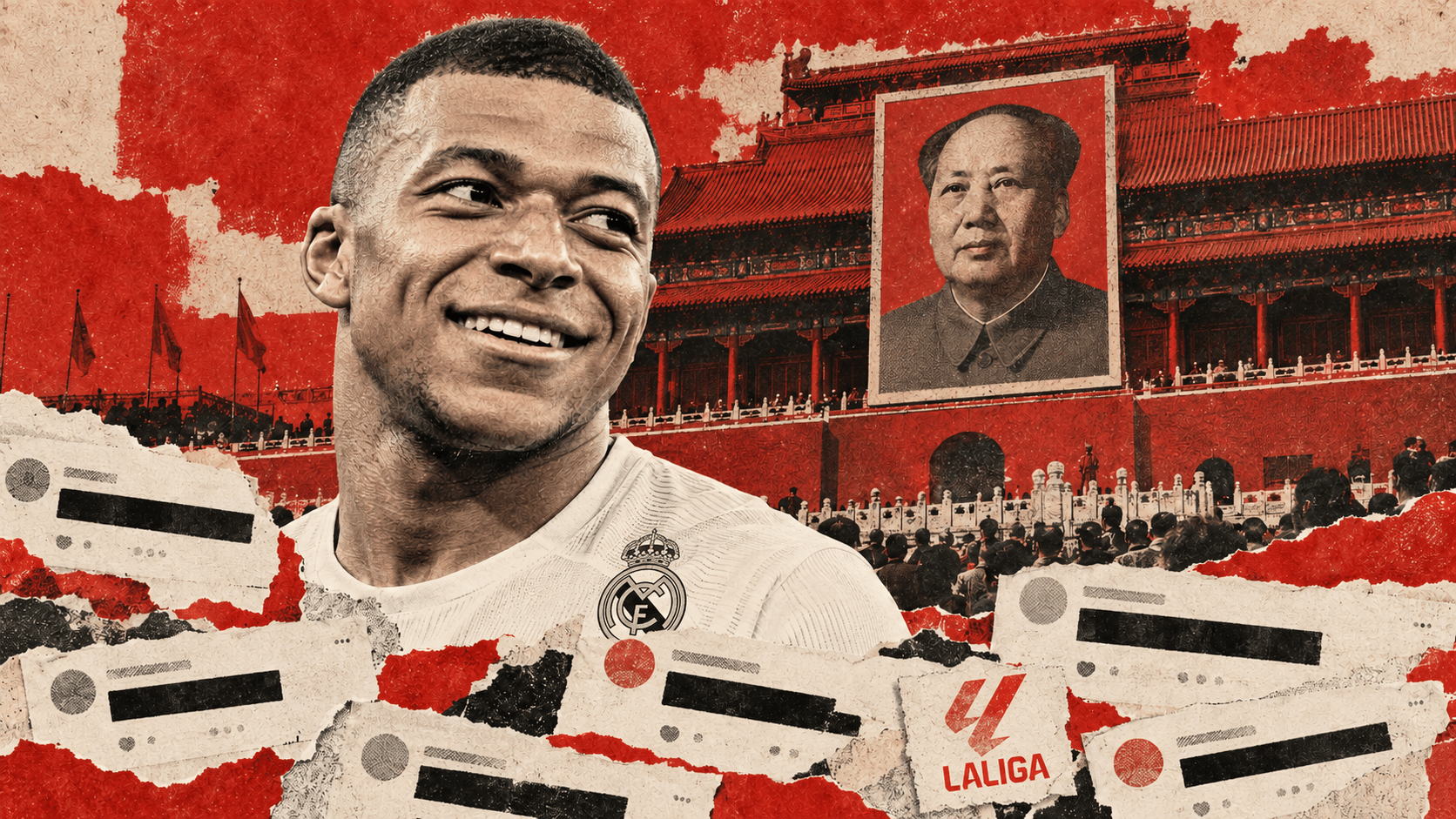
It may be hard to understand how things got so complicated for Mbappé in China this week. After all, all he did was mention his favorite meme in an interview: a photomontage of “a Chinese dictator” with his face superimposed on a portrait of Mao in uniform. The image, which he often uses in chats with his friends, is a playful nod to the outsized influence he is said to wield within his team. In short, a joke. Mbappé, however, was naive, and the fallout was swift.
Within 24 to 48 hours, well-known companies in China, including Dongpeng Beverage, Mengniu Dairy and Milkground, announced they were ending all cooperation with him. The official Weibo accounts of brands such as On, Dior, Rimowa, Nike and Hublot stopped showing related public content on one of the country’s main social platforms. The Chinese Football Association announced it had lodged formal representations with Real Madrid and demanded public apologies from both the club and Mbappé. The controversy escalated to the point that China Media Group, the country’s main state-owned broadcasting conglomerate and holder of the rights to Spain’s LaLiga in China, suspended its LaLiga broadcasts, other matches featuring Mbappé and commercials starring the player. Even football video games began pulling promotional material through updates. And the list goes on.
Damage control kicked in just as quickly. In a statement, Real Madrid C.F. offered “its apologies to the Chinese people for the discomfort that the recent words of our player Kylian Mbappé may have caused.” LaLiga said it deeply regretted “the offense that Kylian Mbappé’s recent comments have caused among Chinese fans.” LaLiga president Javier Tebas even met with the Chinese ambassador to Spain to defuse the situation. Mbappé himself issued a mea culpa in French, English and Chinese, explaining that his “comment was unfortunate” and that he now understood “it had hurt many people in China and Chinese communities around the world.”
One might well ask why the reaction was so disproportionate. But there is a logic to it. The first thing to be clear about is that China’s 1.4 billion people are not “offended,” as their government claims. Just as there are many opinions and perceptions of historical figures across Latin America, there are countless views of Mao in China. Some are positive, others negative, but for the most part they are simply diverse and complex.
In fact, because of censorship, the news that Mbappé “offended the country” is circulating widely on Chinese social media, yet it is hard to find out exactly what he said and whom he was referring to. Sponsorship cancellations, public condemnations and broadcast suspensions thus gained enormous visibility, while the content that triggered them—calling Mao a dictator—remained restricted.
In China, allusions and wordplay are a common way around censorship. Instead of naming Mao, some users refer to “the person on the hundred-yuan bill,” whose portrait appears on that banknote. To write “dictator”—dúcáizhě (独裁者) in Chinese—others replace the first two characters with the initials of their pronunciation and write “dc者.” They also use similar-sounding characters so that readers can decode the message without the censored terms appearing in their usual form.
This is where it helps to draw a line between the government and the Chinese population. It is one thing for an ordinary citizen to take offense; it is quite another for the government to frame it that way. While some people may have taken Mbappé’s words personally, many others laughed at the joke or simply did not care.
To a large extent, what explains the story’s virality and its broad repercussions inside China is the combination of two factors: the Chinese Communist Party’s (CCP) guardianship over the public image of certain historical figures, and its control over the country’s media ecosystem.
Figures such as Mao Zedong and Xi Jinping are untouchable in China. In Mao’s case, it is no coincidence that his portrait hangs over the entrance to the Forbidden City—the former residence of the emperor and seat of the imperial court—with a direct line of sight to Tiananmen Square and the mausoleum where his body lies. It is a patriotic symbol representing the genesis of the People’s Republic of China and the defense of national sovereignty. The Party, for its part, has taken it upon itself to curate, preserve and defend that symbolism against any criticism or narrative that calls the “Great Leader’s” reputation into question. Calling Mao a dictator is understood not only as an attack on him personally, but also as a challenge to China’s political system itself.
This is where censorship and control of the media ecosystem come in. The authorities set the limits of what can be published, while media outlets and platforms monitor, filter and remove content, often in anticipation of possible sanctions. Control combines official instructions, automated filters and human moderation. As a result, expressions deemed offensive can disappear while condemnations are widely disseminated, shaping both the information available and the opinions that can be expressed publicly. In addition, references to leaders such as Mao or Xi face especially strict scrutiny to prevent the circulation of content that questions them or departs from the official narrative.
Imagine a sportswear brand that sponsors Mbappé in China. Its communications team learns of his remarks and immediately recognizes the risk. They could draw criticism from nationalist users, attract the attention of the authorities, or both. Faced with that uncertainty, the team decides it is safer to issue a statement rejecting the comments and distance the brand from the player than to wait and see what happens.
Meanwhile, some users interpret the words as an insult and demand that his sponsors cut ties with him. They film themselves burning a Mbappé jersey and post the video. Other companies see those posts and the first brand’s statement, and decide to speak out too. Each new reaction widens the controversy and increases the pressure on those still keeping quiet. A Ministry of Foreign Affairs spokesperson comments on the matter. A Real Madrid sponsor feels it must also take a step back—even though its relationship is with the club and not the player, the risk is too great. A network broadcasting Spain’s LaLiga reaches a similar conclusion and suspends its broadcasts so that continuing them is not read as indifference to the alleged offense.
This example does not reconstruct what actually happened, but it illustrates how a cascade of mutually reinforcing responses can unfold. Each actor weighs the original remarks, the decisions of others and the possible consequences of not falling in line. The result is a gradual alignment with the positions the state favors, without the authorities having to order every statement, every commercial break or every content removal.
The Mbappé incident is neither the first nor will it be the last. Actor John Cena and former NBA player Dwight Howard apologized after referring to Taiwan as a country. Mercedes-Benz pulled a post featuring a motivational quote from the Dalai Lama. Like so many others, these episodes show that access to the Chinese market comes with political conditions, and that even a casual remark can have commercial and even geopolitical consequences. Mbappé has probably changed his favorite meme.
Translated from Spanish with AI assistance and reviewed by the FAB team. The Spanish version is the authoritative text.