China’s 5G technology investment in Argentina, according to Ambassador Sabino Vaca Narvaja

On October 20, the Argentine newspaper Ámbito held an interview with the Argentine Ambassador to China, Sabino Vaca Narvaja. The interview focused on China’s growing investment, especially in the telecommunications sector, where, according to the ambassador, China is ahead of its development worldwide.

Customs agreement between China and Chile

A customs agreement for authorized economic operator (AEO) status signed between China and Chile came into force on October 8. According to the Chinese General Administration of Customs (GAC), this is the first mutual recognition with China officially implemented in South America.

Brazil and China reach WTO agreement on sugar imports

Brazil initiated a complaint in 2018 at the WTO challenging China’s “safeguard” measure on imported sugar, its tariff quota administration, and its “automatic import licensing” system for extra-quota sugar.

Change of contractor at Hidroituango could reactivate Sinohydro’s participation in the project

Located on the Cauca River between the municipality of Ituango and the town of Puerto Valdivia and estimated to supply energy to a large section of the western Colombia, Hidroituango is one of the most ambitious hydroelectric projects to have been implemented in the country in recent years. Construction of the project began in November 2010, once the tender —in which the Chinese company Sinohydro participated— launched by Empresas Públicas de Medellín (EPM) was won by the CCCI Consortium.

Chronic labor law violations: the real cost of Sino-Venezuelan joint ventures

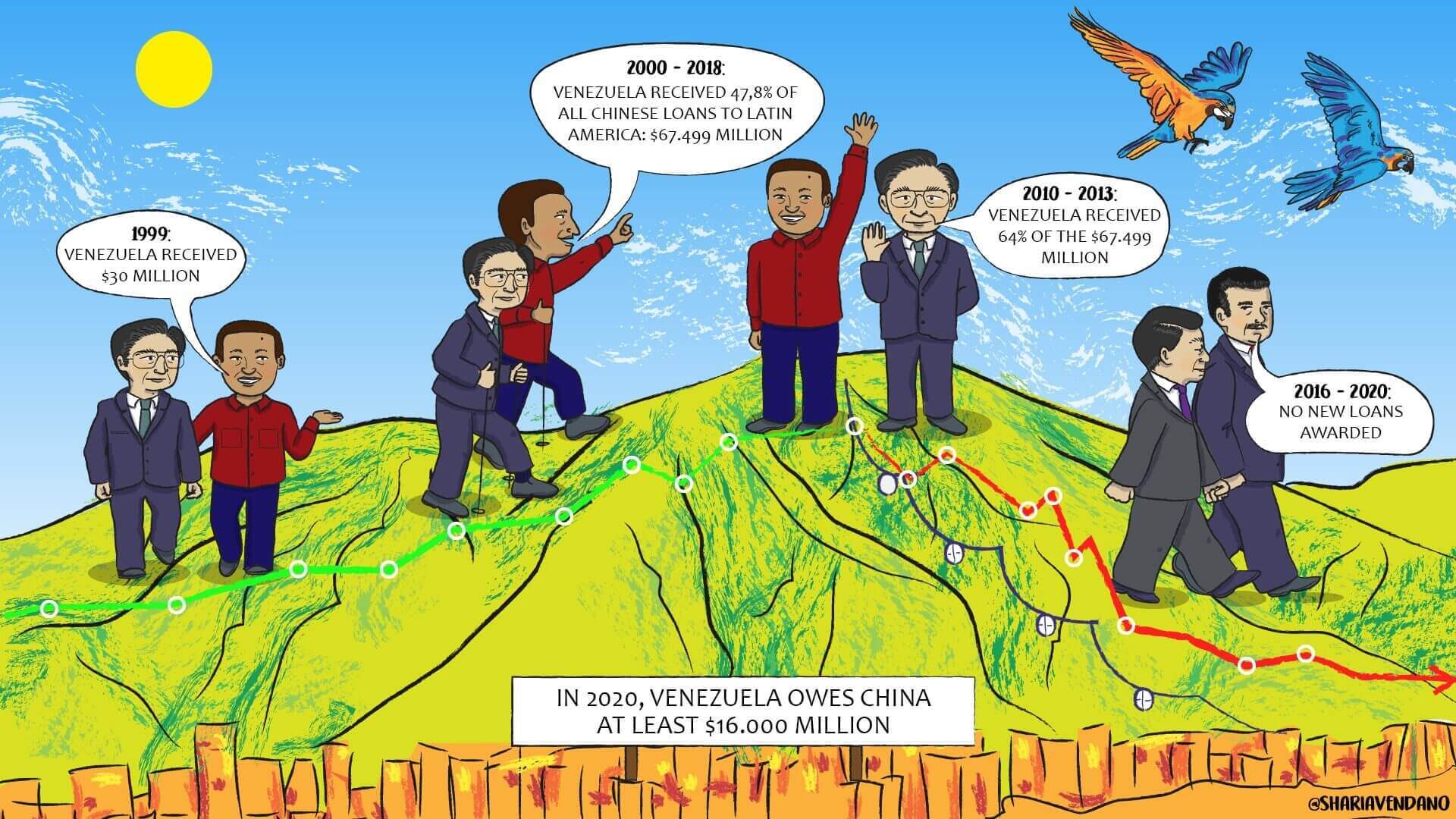
The partnership with China promised to turn Venezuela into a Latin America power. Yet two decades, 468 agreements and over $67bn later, agreements with one of the principal exponents of Chavismo have placed the country at a significant disadvantage. The relationship ended heavily in favor of Asia’s largest economy, leaving Venezuela with a vulnerable labor force, billion dollar debts, and a series of half-finished projects.

Venezuela, revolving door for Chinese interests in Latin America (part II)

Since the turn of the century, close to a hundred Chinese businesses have been set up in all but two of Venezuela’s 23 states. Yet this unprecedented inflow of Chinese capital has not translated into impactful projects. Financed by the two multi-billion dollar bilateral funds set up by presidents Hugo Chávez and Nicolás Maduro with China between 2008 and 2015, at least a quarter are still in an early or planning stage. Since then, issues surrounding the non-payment of loans have caused Sino-Venezuelan relations to cool considerably. Now, researchers from the Kiel Institute for the World Economy warn that at least half of China’s lending in recent years can be considered ‘hidden’. There are concerns that now, and in years to come, the opacity of China’s credit mechanisms could jeopardize crisis recovery in heavily indebted countries such as Venezuela.

Venezuela, revolving door for Chinese interests in Latin America (Part I)

From investment to debt, the dangers of playing against loaded dice.

Between 2000 and 2014, Venezuela received more resources from China than any other country in the world. Despite being located some 14,000 kilometers away, a population of 30 million coupled with enormous energy potential, characterized by an erstwhile billion-dollar oil industry, held significant appeal to China. This, coupled with a new, nationalist political model that appeared compatible to China’s new commercial strategy, provided a catalyst for both nations to strengthen relations. Yet opacity has characterized the signing of almost 500 agreements.


Coronavirus and the Changing Face of Sino-Latin American Relations

From small nations such as Belize and Barbados to heavily populated countries like Mexico and Brazil, the Latin America-Caribbean region is one of infinite diversity. Similarly, the spectrum of productive capacity and levels of gross domestic product is as varied as its climate, flora, and fauna. If we are to develop a clearer understanding of the issues that impact the region as a whole, it is important to consider a variety of perspectives and opinions. To reflect this diversity, we interviewed six Latin American academics, asking them to consider the following question: how has COVID-19 affected the relationship between China and the countries that make up Latin America and the Caribbean?

COVID-19 aid from China to Latin America twice that of US as it increases investments in the region

The global paralysis caused by COVID-19 has brought the world economy into crisis. Yet amid such adversity, China has increased its capital export to Latin America through what analysts have dubbed “mask diplomacy.” Donations of medical supplies to the region in excess of $380m have been the instrument of its latest phase of expansion. Linked in some cases to the concept of guanxi (关系)—the networks of trust and reciprocity of Chinese philosophy—the stage is now being set for further expansion and the continuing battle for global leadership.

« Previous Page