
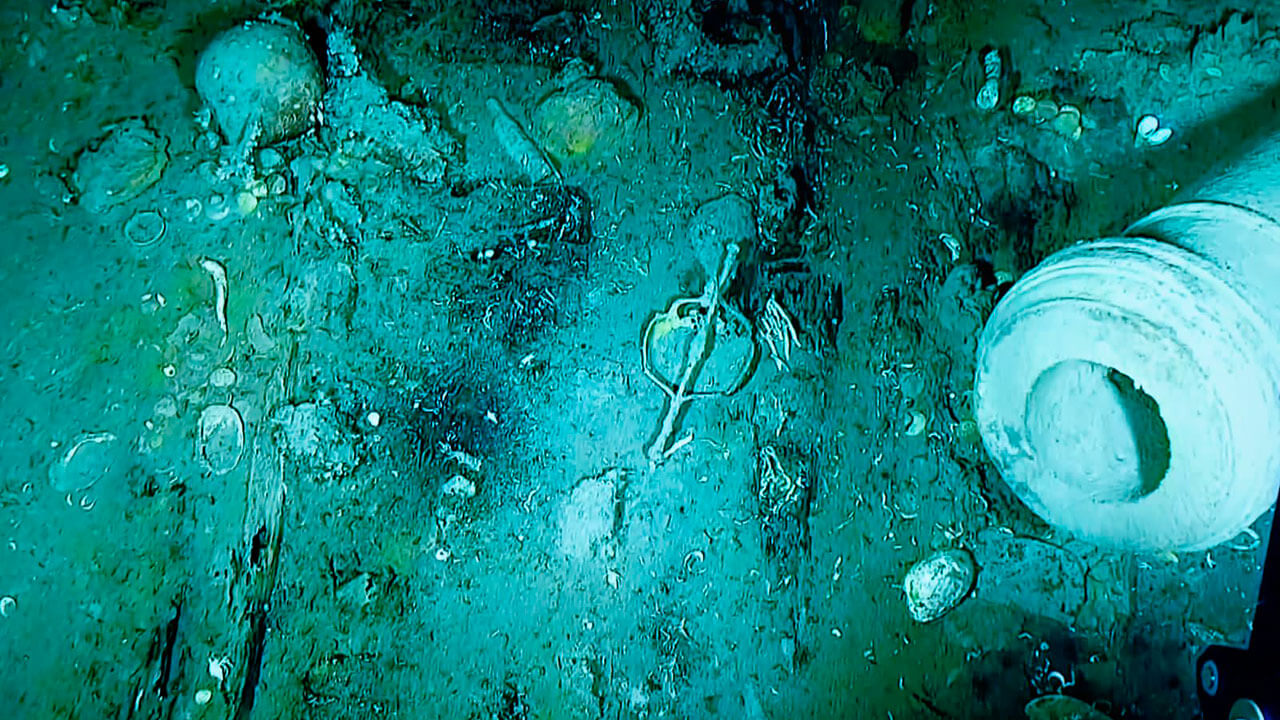
Chinese Kangxi porcelain found intact in Colombia’s San José galleon
Photo: Presidencia de Colombia.
The discovery of Kangxi-era porcelain (1662-1722) in the San José galleon highlights the global reach of Jingdezhen workshops, China’s porcelain capital in Jiangxi province. During the Qing dynasty, these ceramics were exported worldwide, becoming symbols of China’s economic and cultural influence in the 17th and 18th centuries.
The intact collection found in Colombia, composed mainly of blue-and-white porcelain cups, illustrates not only the technical mastery of Chinese kilns but also the high demand for such goods in the Americas and Europe. The Manila Galleon route directly linked Guangzhou with the Philippines, from where porcelain and other Asian luxuries traveled to Acapulco, then on to Cartagena, Havana, and ultimately Spain. The fact that these Chinese goods were aboard the San José shows how deeply Chinese porcelain was embedded in colonial Atlantic trade networks.
The Kangxi reign is regarded as a “golden age” of imperial porcelain, marked by innovation in glazes and large-scale production for overseas markets. Its survival in Caribbean waters provides scholars with a rare opportunity to study not only material culture but also the way China projected its soft power centuries before modern globalization.
For historians, the significance of this discovery goes beyond Colombian maritime archaeology. It underscores that the relationship between China and Latin America is not merely a 21st-century phenomenon but one with deep historical roots, where Chinese art and craftsmanship played a role in shaping transoceanic exchanges more than three hundred years ago.
* Original text in Spanish. Translated by Large Language Model (LLM) technology.
Main Source:
Related News:
Colombia hits record trade deficit in commerce with China
China to form expert group to advise Colombia on railway projects
China expands role in Colombian infrastructure with CCECC rail partnership