The tariff conflict between the European Union (EU) and China over electric vehicles has created commercial tensions that could reshape global economic relations, opening strategic opportunities for Latin America. By imposing tariffs to protect its automotive industry from subsidized Chinese competition, the EU has prompted Beijing's retaliation, including measures against European dairy products.
This scenario provides Latin American countries with a chance to position themselves as key partners for supplying essential raw materials and exporting goods like dairy products. Seizing these opportunities requires addressing challenges, such as balancing trade relations with China to avoid dependency and ensuring equitable benefits. Amid geopolitical shifts and global risks, Latin America must strengthen its trade strategies and leverage market diversification dynamics from both powers to solidify its position in international trade.
The tensions between the People's Republic of China (PRC) and the European Union (EU) over the imposition of tariffs on Chinese electric vehicles represent a turning point in their trade relationship. This conflict has strained bilateral dynamics and, if prolonged, could push both parties to seek alternative markets, potentially creating opportunities for third parties, including countries in the Latin American and Caribbean (LAC) region. This document explores the causes of these differences, their development, and how this scenario could influence trade and geopolitical relations between Latin America and the Asian giant.
"With increased tariffs on Chinese electric vehicles, the European Union seeks to protect its strategic industries, while China expands into alternative markets."
Since June of this year, the EU decided to increase tariffs on electric vehicles imported from the PRC, arguing that the European automotive industry is vulnerable to unfair competition from Chinese manufacturers who receive government subsidies. These subsidies allow them to sell their vehicles at lower prices in the European market, exerting competitive pressure on local electric car manufacturers such as Stellantis and Renault. The EU’s decision arises in a context of technological dependency and an urgency to protect its strategic industries. This is considering China's expansion in sectors such as renewable energy and electric mobility. In response, Beijing has labeled this decision protectionist and retaliated with trade measures, triggering a tariff offensive with negative consequences for both economies.
For its part, the PRC rejects such accusations, arguing that Chinese electric vehicle manufacturers have achieved a competitive advantage through development and technological advancements. According to the Chinese government, the tariffs imposed by the EU are a protectionist measure that violates international trade rules and the principles of the World Trade Organization (WTO). Consequently, China has responded by adopting measures against the European dairy market, launching an anti-subsidy investigation widely interpreted as possible retaliation for the EU’s anti-dumping measures targeting its electric vehicle market. These measures affect various sectors, from agri-food to luxury industries. However, China’s response is not limited to tariff measures but also includes a potential reorientation of its trade strategy toward alternative markets, such as Latin America, Africa, and Asia.
What Opportunities Does This Present for Latin America?
This trade conflict represents a potential opportunity for LAC in its role as a supplier of raw materials and a trade partner for both parties. On the one hand, the European Union could seek to deepen its presence in the region to counteract China’s influence, which has intensified over the past decade through investments primarily in hydrocarbons and infrastructure. This could translate into increased offers of investment and technological cooperation, especially in energy transition projects. On the other hand, China might strengthen its bilateral agreements in LAC to secure the supply of raw materials and offset the barriers imposed by the EU.
Over the past decade, LAC has been an attractive region for China due to its natural resources. However, China's geopolitical interests are not limited to the extraction of elements such as lithium, carbon, copper, and nickel—key inputs for manufacturing batteries and electric vehicles. The deepening of trade relations to import food and other agricultural products to feed its population is also crucial. Among these goods are dairy products, which, along with brandy and other milk derivatives, have become tools for China’s retaliatory measures against the EU. The potential reduction in EU dairy imports could create business opportunities for LAC countries.
"The conflict over tariffs on Chinese electric vehicles could position Latin America as a key supplier of raw materials for both blocs."
China has effectively diversified its market to avoid commercial dependence. Since joining the WTO in 2001, it has leveraged trade relations as a geopolitical strategy to position itself as a key global actor. Despite ideological differences with the United States (US) that have led to trade impasses, including increased tariffs on Chinese technological, machinery, and textile products, China has managed to balance these sanctions by enhancing its production capacity and strategically leveraging its trade relations with developing countries. This strategy could be extended to the LAC region amid this trade dispute, given the dairy production capacity of several LAC nations.
For instance, Argentina’s dairy production and export show a growth trend, with a 6.4% increase in volume in the first quarter of 2024 compared to the same period the previous year. Exports of powdered milk, accounting for 43.3% of total export value, grew 18.8% in volume, though revenues fell by 5% due to declining international prices. In terms of equivalent milk liters, exports represent 30.1% of total production, with key export destinations including Chile, Paraguay, Uruguay, and Ireland.
"China is diversifying its market towards Latin America in response to barriers imposed by the EU, strengthening cooperation in sectors such as dairy production."
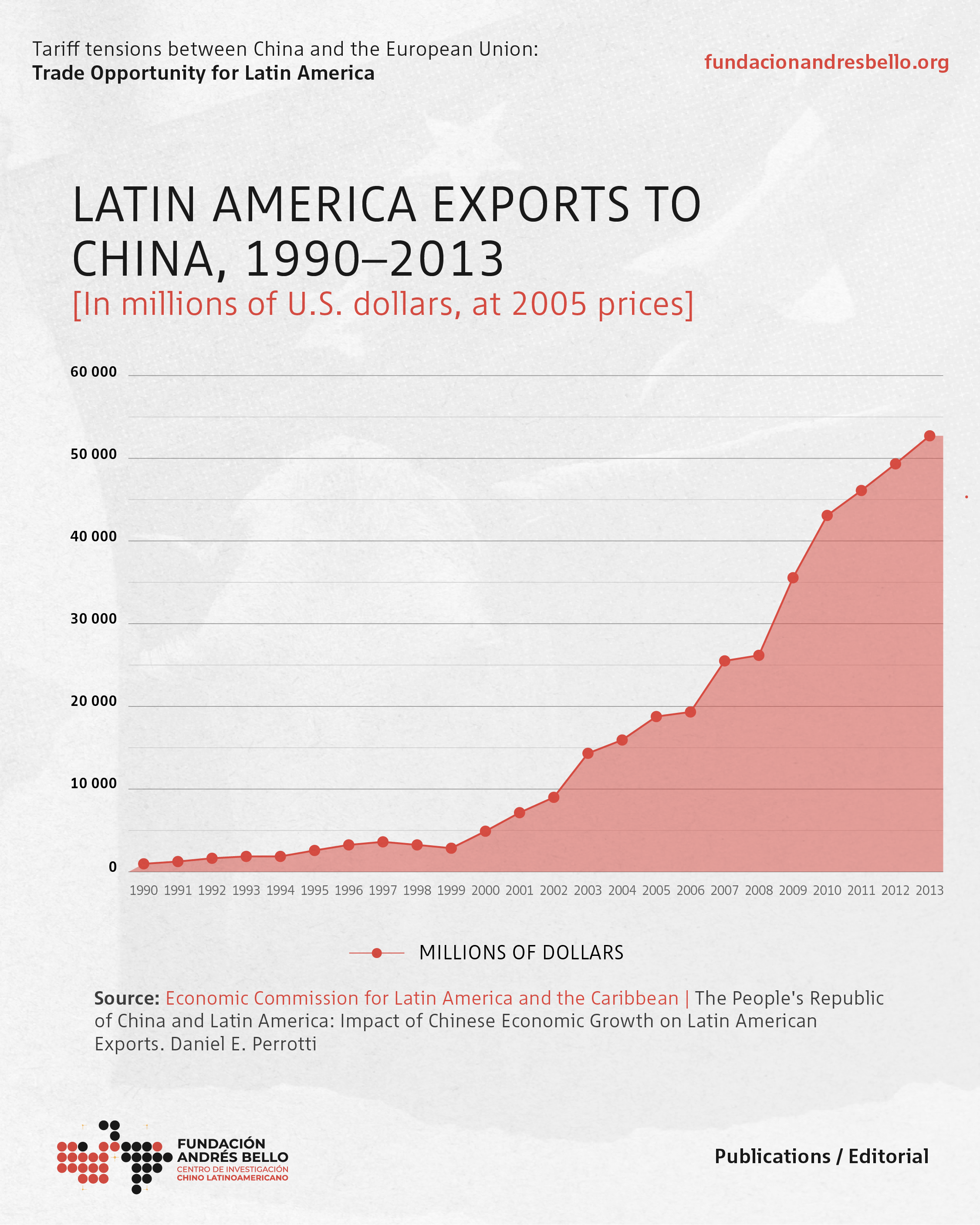
LATIN AMERICA EXPORTS TO CHINA, 1990-2013
Source: Economic Commission for Latin America and the Caribbean | The People's Republic of China and Latin America: Impact of Chinese Economic Growth on Latin American Exports. Daniel E. Perrotti
Key Dairy Producers in Latin America
Meanwhile, Brazil is the main destination for Uruguay's dairy exports, representing 49% of sales over the past 12 months, focused on products like whole and skimmed powdered milk and cheeses. However, revenues from these exports fell by 17% in the first quarter of 2024 compared to the same period the previous year, highlighting declines in products like whole powdered milk and butter. This drop occurs in a context where China could see a strategic opportunity in Uruguay’s dairy products to diversify its supply sources, given its growing demand in the food sector.
Although not all countries in the region have the same dairy production capacity, nations like Chile, Mexico, Nicaragua, and Costa Rica rank among the top 10 LAC countries for dairy exports. While they lack the prestige of producers in stable economies such as New Zealand and Belgium, the Latin American market has increasingly become a focus for Chinese investments and trade, making China the region's second-largest trading partner to date.
"Although dairy production capacity varies across countries in the region, Chile, Mexico, Nicaragua, and Costa Rica have the capacity to produce and export dairy products, ranking among the top 10 Latin American and Caribbean countries in this sector."
Leveraging China as the world's largest importer offers significant advantages for Latin American countries, as its market presents considerable commercial opportunities. However, the PRC is often criticized as a "win-lose" partner, where benefits typically favor the Chinese side. This underscores the need for Latin American countries to develop robust negotiation strategies and trade policies that maximize the benefits of this relationship while protecting national interests and strategic resources. Understanding the current state of China's trade relations with other actors, such as its commercial conflict with the EU, is key to designing these strategies and identifying potential opportunities for cooperation or competition.
The tariff dispute between the PRC and the EU marks a milestone in their trade relations and opens a window of opportunity for LAC. As a key supplier of raw materials, the region could become a strategic partner for both blocs as they seek to diversify markets and secure supplies. In this context, China could strengthen its relationship with the region through increased cooperation in sectors like dairy production.

"Leveraging China's role as the world's leading importer presents trade opportunities, but Latin America must negotiate with strong policies to protect its strategic resources."
These opportunities are reflected in the benefits that Latin American countries could derive from China's trade offers. However, this also requires careful planning and solid trade strategies to maximize advantages while safeguarding national interests. This scenario poses a challenge for trade strategies in the region, particularly for countries with closer commercial ties to the United States than to China, such as Colombia, which recently expressed interest in joining the Belt and Road Initiative.
Furthermore, international events like the war in Ukraine must be considered, as they could disrupt not only dairy production—a key export for Latin America—but also global trade flows. In this context, Latin American countries must remain vigilant and proactive, adapting to changes in the global geopolitical and trade landscape to strengthen their position in relations with China and other markets.
Related News:
Ecuador prepares to export high-protein milk to China
External Links: (Spanish)
China eleva la tensión comercial con la UE al imponer aranceles al brandi europeo – El País